Showing posts sorted by relevance for query mcbride. Sort by date Show all posts

Monday, May 11, 2009

McBride is Live


I know of few things that can produce the feeling you get when you hear a solo for the first time that completely captivates you. The artist pulls away from the microphone and you realize all in that moment, that you just heard something incredible that will almost never be reproduced the same, unless someone had the forethought to record it. But even then, if you heard it live, the recording does it no justice. But if you hear the recording first and you feel that way, you know you’ve heard something special.

That’s exactly how I felt when I heard the opening piece of CHRISTIAN MCBRIDE‘S LIVE AT TONIC. The opening piece is titled TECHNICOLOR NIGHTMARE. Its violent from beginning to end. I can’t ever recall listening to a Jazz piece that was so loud and percussive from every instrument on the stage - and then finding out it was just four musicians. But never does it become obnoxious and too loud.

The beginning of the song finds McBride bowing a solo on what I believe to be an upright bass with electric pickups. Though I can’t see him playing, I imagine that he is throwing his entire being into the instrument.

McBride is joined on this date by keyboardist, GEOFFREY KEEZER, reedman RON BLAKE and drummer TERREON GULLEY. The core is just four. Wow! Blake is becoming more a force to be reckoned with. This album is 2 years old, so imagine what I must be thinking of him now. This set also features appearances by CHARLIE HUNTER on Guitar, JASON MORAN, JENNY SCHEINMAN, DJ LOGIC, and SOULLIVE’S ERIC KRASNO AND RAHSAAN PETERSON. This on any night would make for an all star jam session. Thankfully - it was recorded!

You won’t meet anybody who purports to know enough about jazz to write about it to say they don’t like MILES DAVIS’ foray into Rock and Fusion. However you may find one or two so called purists who would dare suggest that Davis’ fusion period may have been lacking. I’m not one of those writers. I loved BITCHES BREW and I love McBride’s take on it. Keezer’s integrity to the melody gave Blake plenty of room to play.

This 3 disc set was released in 2006, and it was buried amongst many of the recordings I had acquired in those years - I forgot I had it. Now I hate I didn’t listen to it then. But I’m glad I found it. It is truly a gem.

Even if you had never heard his music, McBride’s resume is unreal and I wouldn’t be afraid to say unparalleled by any of his contemporaries. He’s played with WYNTON, STING, GEORGE DUKE, ROY HARGROVE, PAT METHANY, BILLY HICKS, ?UESTLOVE of the hip hop super group THE ROOTS, and BOBBY WATSON. Playing with as many different musicians as possible has made him even more brilliant.

Musically, everything is here - “From bebop to hip hop to funk to fusion”. I’m not that clever I quoted that lyric from SY SMITH. Sonically, its loud where it needs to be and soft where it needs to be.

More than unearthing this from my collection, I wish I had been there to hear it!

Thursday, October 15, 2009

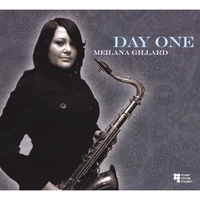
DAY ONE - Meilana Gillard


By conditioning, I don’t believe girls can play or maybe shouldn’t play saxophones. They are best left to playing flutes and clarinets. And if by chance they play Alto or Bass Clarinets, maybe even bassoons, that is as close as they should get to the “saxophone”.

I promised myself I would spend the year seeking out new jazz artists attempting to push the envelope and keeping the flame - you know preserving the art. I have done a piss poor job because I find myself locked into my likes. Not that my heroes aren’t still producing forward thinking music but that is what is expected of them, being my heroes and all. But I have been less inspired by some of the “new” music by less proven artists being released.

Recently, I ran across a very mild mannered request from an artist, on a website that I frequent, to listen to her record. The request wasn’t directed at me specifically but when I realized it was a jazz recording, I felt it my duty to give it a listen. And WOW, I like this record!

Introducing, MEILANA GILLARD and her debut record entitled, DAY ONE on Innercircle Music. The label is the brainchild of master saxophone player, composer, educator Greg Osby - another hero of mine.

After trading a few emails with Meilana, she sent me the download of her record. After I downloaded it, I intended to begin my first listening while I was doing other things. It proved to be an impossible task as I was immediately interested from the downbeat of the first song. As I stated earlier, I was conditioned to believe girls can’t/shouldn't play saxophone. I had preconceived notions that this might be some candy shop or Candy Dulfer type jazz recording. The reason I couldn’t stop listening intently is because all my preconceived notions were most immediately eradicated.

The group consists of Gillard on Tenor Saxophone, Bass Clarinet, Flute; Nir Felder: Guitar; Sam Barsh: Fender Rhodes, Nord & Korg keyboards; Marcos Varela: Bass; and Tyshawn Sorey: Drums. By virtue of the use of Fenders, Nords and Korgs it is apparent that this would be a different type of recording. The use of the electronic instrumentation gives the record a phenomenal sound. The songwriting and arrangements fit this personnel extremely well. Knowing that Gillard penned every song except one makes her play that much more interesting. The only thing that concerned me was some of the tempo/feel changes. It sometimes feels a bit rushed. But this is my own bias. I am not a fan of that particular effect in most recordings.

Gillard’s improv skills seem to be more learned than natural. By no means would I suggest that this is a bad thing. In fact, I believe that it was probably just a case of the “I wanna do this right on the debut record” jitters. Because in the end, she sounds really good.

I judge all saxophone players abilities by how they handle ballads. Ballads expose you like nothing else. The ballads “SEMISWEET” (please follow the link to the hip hop remix of semisweet...it too is quite funky)and “A SPIRIT REMEMBERED” are handled with great dexterity and feeling. The fact that she exposed herself by playing the first 12 or so bars of the latter sans accompaniment, proves she’s confident in her ability and rightfully so.

Drummer Sorey is a groove machine. His ability swing inside his grooves were masterful. Felder, Barsh, and Varela hold the ensemble together quite nicely. Their dedication to the melodies and to the grooves made the lead work that much more interesting. They always played with each other and never seemed out of sorts.

This record mostly reminded me of the hybrid jazz-funk fusion of the late 60s and 70s by bands like CATALYST. Or even more recent funk offerings by CHRISTIAN McBRIDE and his work with THE PHILADELPHIA EXPERIMENT. However, it’s not quite as avant garde so it will be a more palatable for music listeners who don’t enjoy the challenge of more free form jazz.

I like Meilana Gillard’s music and this band. I think DAY ONE is just the start of many more days to come.

Friday, July 22, 2011

Geri Allen - So Colorful


I was first exposed to GERI ALLEN on a documentary called Robert Altman’s Jazz ‘34: Remembrances of Kansas City Swing. The film was a tribute to “cutting contests” and jam sessions in Kansas City Jazz clubs in the 30s. The scene was set in what would be described as a juke joint and all the artists were dressed in 30s attire. The players included such giants as Ron Carter, David “Fathead” Newman all the way to young lions – at the time, but much seasoned now - like Christian McBride and Nicolas Payton.

Of course, what caught my attention first was Geri is a woman. It can’t be denied that the tradition didn’t boast many women as players. Mary Lou Williams was one of the few exceptions. In my opinion, swing, in the south, from the 30s, was very physical. It took a lot of agility, especially for rhythm section artists. So my quest began to find out who this woman was banging away with the big boys.
Shortly after seeing the documentary (I’m sure I didn’t see the first airing), I ran across my first Allen recording, THE GATHERING, Verve, 1998. I didn’t stop listening to this record for at least a month. I took it from my car to the office to the car to the house – and back again.

THE GATHERING takes on a dark, soulful, emotional, all-encompassing tone. Allen is one of those musicians who tend to describe sound in terms of color palates, a synesthete. I won’t pretend that I always understand or see what one sees when describing sound as color. However, with this record, I can see vivid colors of beautiful sunsets, clear starry nighttime skies and full moons on ocean vistas. While classic in nature, this record is an exercise in post-bop progressivism. An example of my characterization is the tune DARK PRINCE. This tune juxtaposes a classic jazz trio ensemble (piano, drums & bass) with an electric lead guitar accompaniment from VERNON REID of LIVING COLOUR. As Allen leads the ensemble through the funk filled, infectious groove, you can hear Reid compliment it with an unobtrusive wailing that lends itself to a soulful mystery. This song alone will make you understand why it was so difficult to put this record away for such a long time. Allen’s chops are phenomenal. I love her most because she’s an ensemble-ist. When it’s time to groove, she grooves. When it’s time to accompany, she accompanies. When it’s time to shine, she takes over. Without a doubt, she’s equally comfortable in all three arenas.

I started thinking about how much I liked THE GATHERING and Allen when I ran across an interview on Marian McPartland’s Piano Jazz on NPR. Her virtuosity was put on display in the studio in a solo format. She performed several pieces. Most of the compositions were her own; however, she blessed the listeners with a luscious version of Billy Strayhorn’s LUSH LIFE. Allen and McPartland also jammed a little while on two pieces including Charlie Parker's ANOTHER HAIRDO.

Allen's latest project is entitled, GERI ALLEN AND TIMELINE - LIVE, Motemaa, 2010. TIMELINE features KENNY DAVIS on Bass, KASSA OVERALL on drums and features MAURICE CHESTNUT, a tap dancer as part of the rhythm section.

Allen is married to trumpeter WALLACE RONEY. I have got to find my tape of Roney playing optional lead to Miles Davis at the Montreaux Jazz Festival the last time Davis ever performed any of his Cool Bop music. Allen is also busy teaching Jazz at the University of Michigan.

I’ve not heard this new recording in its entirety...I can't wait...

Wednesday, December 17, 2008

Earfood


I won’t lie. Growing up, I hated this kid. His arrogance offended my arrogance.

Hargrove and me grew up playing in bands together, first middle school and then in high school. My mother wouldn’t allow me to attend the Booker T. Washington High School for the Performing Arts in Dallas, but I continued my wingman position as a member of the wall of sound (at least in our minds) cover/show band, THE FUTURE.

Erykah Badu once lamented, “Roy Hargrove has a relationship with music that most people never get”. Now it took years for her to say this but if I had the wisdom to use those words at age thirteen, I would have said exactly the same thing. But at thirteen it just comes out as, “How did he hear that?” When we were under the tutelage of our mentor S. Dean Hill, he would use a term to describe the extraordinary ability of a young musician to interpret and play what he heard or improvise with skill and precision. He would say, “He’s got big ears…” He often said that about Grove. And I agree. I may have hated this kid because of his arrogance. But he was arrogant because he knew he would be a star…and the rest of us knew it too.

I must admit I was a fan of his playing from the beginning. Everything about playing music at that point in our lives was about blasting notes in high registers. I was an alto player and I remember the first full band practice we had, I couldn’t stay in my seat for trying to see who the trumpet player was that was “screamin’”. Until then, the only people I knew who had that ability were my cousin Don and his band mates at one of the local high schools and the trumpet players at Prairie View A & M and Grambling State. Also the way he twisted melodies when he improvised was so cool. He was way mature in his playing. Our middle school Jazz Band played a tune arranged by Maynard Ferguson, The Way We Were that featured a written solo that Ferguson himself played. Grove sounded exactly like the record. I was amazed.

I decided to make owning Hargrove’s catalog a priority after his first record Diamond in the Rough. I decided to do so mostly out of loyalty to an old band mate who I wanted to see succeed. But the more I listened to his records, I started buying out of fandom too, not just loyalty. I even became a fan of a couple of his early sidemen, most notably, sax man Antonio Hart and pianist Marc Cary. Hart’s Don’t You Know I Care, from the recording titled the same is one of my most favorite ballads. And Marc Cary’s record, Rhodes Ahead, which is his foray into jazz by way of electric pianos led by his Fender Rhodes play, made me view electric music in a different way. I also believe that, by Grove’s very appearance on the record, led him to the work he did on The RH Factor think Liquid Streets.

I think Hargrove’s document, With the Tenors of Our Time¸ is brilliant in form and content. I could only wish that Sonny Rollins, my 2nd favorite sax player had been on this date. But Joe Henderson (my favorite sax player) was there and that adds to its brilliance for me.

Earfood is Roy’s latest offering. I think the title is mad corny, but the record is incredible. Or should I say it’s nourishing to be as corny as the title. When Grove stepped on the scene, he brought bop back to the underground and his name became significant with the Boho set. Those who followed jazz found his sound to be energetic and fun. The moniker, young lion, fit him well. Most of the boho set came to him via Badu’s Mama’s Gun, and D’Angelo’s Voodoo. During this period, he also made appearances on Common’s Like Water for Chocolate and John Mayer’s Heavier Things.

For me, Earfood, has become one of those theme music recordings. I find that it has served as a soundtrack for many of daily activities. From the mundane driving to work to leaving it on in the garage while I sort Christmas lights and string them on trees. It just works.

I find it difficult to put this record in just a “jazz” category because it plays like an amalgamation of Jazz, Soul, Funk and Gospel. My guess is the title speaks to ones need for a well-balanced meal. And whatever you like about music, I think you will find it here. This is the reason I love this record on so many levels. I can point to specific songs on all of the previous documents that make me stop and listen. This record has fewer weak spots. But regardless how weak I may suggest one or two of the cuts are on this record, Hargrove still plays with a bravado and self-assuredness that reminds you to be cool while listening.

If I wanted someone to love this record as much as I do, the first cut I would play him or her is Strasbough/St. Denis. It’s a funky four anchored by a bass line that grooves as hard as any funk cut you’ve ever heard. The call and response part of the melody between he and his sax man is playful and spirited. The intro is a cut penned by Cedar Walton, I’m Not So Sure that will put you in the mind of Trying To Make It Real Compared to What. Grove never played much Flugelhorn while we were in school. He could play it like most instruments, but it wasn’t his “axe”. Clearly, by way of the ballads on this recording, he is becoming much more comfortable. “Lush” is the word that would aptly describe his Flugelhorn playing.

Though he won a Grammy for his Latin Jazz document, Habana, this may be his best yet.

Discography:
Ear Food [The Roy Hargrove Quintet] (Emarcy, 2008)
Distractions [The RH Factor] (Verve, 2006)
Nothing Serious [The Roy Hargrove Quintet] (Verve, 2006)
Moment to Moment (Verve, 2000)
Crisol: Habana (Verve, 1997)
Parker's Mood (Verve, 1995) [Trio w/ Christian McBride (Bass), and Stephen Scott (Piano)]
Family (Verve, 1995)
With the Tenors of Our Time (Verve, 1994)
Approaching Standards (Jive/Novus, 1994)
Of Kindred Souls (Live) (Novus, 1993)
The Vibe (Novus, 1992)
Toyko Sessions (Novus, 1991)
Public Eye (Novus, 1990)
Diamond in the Rough (Novus, 1989)
The RH Factor, Distractions (Verve, 2006)
The RH Factor, Strength [EP] (Verve, 2004)
The RH Factor, Hard Groove (Verve, 2003)